Spring is a great reminder that not all driveways are created equal. After weeks of heavy rain, it quickly becomes clear which driveways are draining properly and which ones aren't.
Pooling water, soggy edges, and muddy run-off onto the road are all signs that something isn't working as it should. Left untreated, poor drainage doesn't just look unsightly. It causes real damage to your driveway surface, your foundations, and potentially your property.
The good news is that most drainage problems can be fixed — and in many cases, prevented entirely with the right approach from the start.
Why Drainage Matters More Than Most People Realise
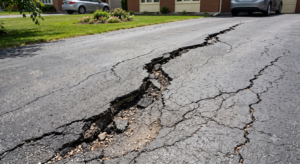
Water is one of the biggest threats to any driveway surface. When it has nowhere to go, it sits on the surface and works its way into any crack or weak point it can find. Over time, this leads to:
- Frost damage in winter (water expands when it freezes)
- Erosion of the sub-base beneath the surface
- Cracks and potholes forming prematurely
- Sinking or uneven areas developing
- Damage to neighbouring flower beds, lawns, or boundary walls
A driveway that drains well will simply last longer. It's as straightforward as that.

The Most Common Driveway Drainage Problems
Water pooling on the surface
This is the most obvious sign. If water sits in puddles on your driveway after rain rather than draining away, the surface either lacks sufficient fall (gradient), or the drainage beneath it has failed.
Flat driveways are particularly prone to this. Every surface needs a gentle slope to guide water away — even a small one. Without it, water has no route to escape.
Water running towards the house
This is the most serious problem. If your driveway slopes inward towards your property, rainwater is being directed straight at your foundations and possibly your garage or front door. This needs urgent attention.
Water pooling at the edges
Often caused by raised or inadequate edging, or a sub-base that has shifted over time. Water collects along the borders of the driveway and softens the surrounding ground, which eventually undermines the surface itself.
Water running onto the pavement or road
Not just a nuisance — this can also be a planning issue. Driveways are required to drain water within the boundary of the property rather than letting it run into the public highway. Channel drains installed at the driveway entrance are the standard solution.
Soft or spongy areas underfoot
If parts of your driveway feel soft or bouncy, water has likely got into the sub-base and saturated it. This weakens the structure from below, and surface repairs alone won't solve the underlying problem.
Noticed a drainage problem on your driveway?
We offer free, no-obligation assessments across Suffolk, Essex, Norfolk, Cambridgeshire, and beyond. A quick site visit is usually all it takes to identify the cause and recommend the right fix.
Call us on 01787 275929 or email
What Causes Poor Drainage?
Most drainage problems come down to one of three things:
Poor original installation. A driveway laid without proper groundworks — incorrect gradient, no drainage channels, or an inadequate sub-base — will always struggle with water management. It's a fundamental issue that no amount of surface patching will correct.
Drainage systems that have failed or are blocked. Channel drains and soakaways can become blocked with silt, debris, and roots over time. A system that worked well five years ago may simply need clearing and servicing.
Changes to the surrounding environment. Tree roots can disrupt drainage systems. Ground movement can alter gradients. Extensions or alterations to neighbouring properties can redirect water flows. Drainage that was designed for one situation may not cope with changed conditions.
The Drainage Solutions That Work
Correct gradient
Every driveway should be laid with a gentle fall, typically around 1 in 80, to guide water away from the property and towards drainage points. Getting this right at installation is far simpler than correcting it afterwards.
Channel drains
A channel drain (sometimes called a linear drain) is installed across the width of the driveway, usually at the entrance or at the base of a slope. It intercepts surface water and directs it away safely. This is a highly effective solution and is commonly required where driveways adjoin the public highway.
French drains
A French drain is a gravel-filled trench with a perforated pipe at the base. It's installed along the edges or across the middle of a driveway to collect and redirect water underground. Particularly useful on sloping ground or where surface water tends to collect at specific points.
Soakaways
A soakaway is an underground chamber filled with aggregate that allows water to disperse slowly into the surrounding ground. They work well in areas with suitable soil, and are often used in combination with channel drains and French drains.
Permeable surfaces
For properties where traditional drainage options are limited, permeable surfacing is worth considering. Resin-bound driveways, for example, are naturally porous — water passes straight through the surface and into the sub-base, rather than running off. This can dramatically reduce surface water issues without the need for extensive drainage infrastructure.
Is It Time for a Proper Fix?
If your driveway has persistent drainage problems, it's worth getting a professional assessment rather than waiting. Small issues tend to get worse over time, and what starts as a pooling problem can develop into structural damage that requires far more extensive work to put right.
At Heritage Roadways, we assess drainage as part of every survey we carry out. Whether you need a channel drain installed, a soakaway replaced, or a completely new driveway laid with proper groundworks, we'll give you honest, straightforward advice on the best solution for your property.
We've worked on everything from private residential driveways to the grounds of Highclere Castle and Blenheim Palace — and proper water management is something we take seriously on every single project, regardless of scale.
If spring rains have highlighted a problem with your driveway, call us on 01787 275929 or email for a free, no-obligation assessment.